Owen and Bailey’s father–daughter relationship
The Last Thing He Told MeOwen and Bailey’s father–daughter relationship is the emotional center of the novel’s conflict between protection and presence. Owen’s care for Bailey is expressed not only in their shared affection but in decisions made for a crisis he hopes never to face: he arranges for Hannah Hall to be Bailey’s primary guardian, teaches Bailey how to communicate privately, and ultimately remains away because he believes his return could put her at risk. Bailey’s insistence that she knows her father gives their separation its defining tension: his absence is devastating, but it does not erase her trust in who he is.
A Bond Made Visible in Small Acts
The relationship appears through domestic memories as well as declarations. Bailey recalls a meal of dumplings with Owen and Hannah at the Ferry Building, when Owen took Bailey’s phone and installed Signal. He explained that messages on the internet do not simply disappear, then made a joke about using the app for private messages. Bailey responded with mock disgust; Owen turned serious and told her that she could use it for any call or text she wanted to disappear. He repeated the instruction so she would remember it. The exchange holds humor and foresight together: a familiar father-daughter joke becomes a practical lesson in staying safe.
The app also shows that Owen prepared Bailey for a world in which ordinary communication might be dangerous. His guidance is not abstract. It gives her a specific means to reach him without exposing the contact in the usual way, and it later becomes the channel through which she hears his voice again. The memory of the lesson lets Bailey—and Hannah—understand the incoming Signal call as part of Owen’s care rather than an unexplained interruption.
Owen’s affection is also reflected in Hannah’s understanding of the person Bailey has become. When Hannah considers a future without Owen, she thinks of Bailey as the young woman who has grown up under his watchful eye, and of how proud he is of her. Bailey’s anticipated college years, still two years away, make the cost of his absence concrete: he has helped prepare her for a life ahead, but may not be present to see its next stages.
Preparation, Trust, and the Choice of Guardian
Owen’s preparations establish Hannah as more than a temporary companion. The guardianship document names her Bailey’s primary guardian if Owen dies or becomes unable to care for her. Hannah understands that Owen made this arrangement so Bailey could stay with her. The provision does not remove the pain of his disappearance, but it reveals a deliberate act of trust: Owen had decided that Hannah could protect and raise Bailey if he could not.
That trust carries practical consequences. Earlier, Hannah fears that Bailey might be taken from her because she is not a blood relative and has not adopted her. Grady Bradford tells her he has contacted a California family-law official to help secure temporary custody if someone seeks it. The legal uncertainty underscores how vulnerable Hannah’s position could be; Owen’s formal arrangement, by contrast, gives her a recognized role in Bailey’s care. Their relationship is therefore held together not only by affection but by Owen’s effort to make that affection count when institutions and danger threaten to separate them.
Owen’s instruction to protect Bailey recurs as a compact expression of his priorities. It is not a promise that he can stay beside her. Instead, his arrangements place her safety and continued life with Hannah ahead of his own wish to return. Hannah later argues that Owen left Bailey with her because he could not guarantee that danger would not reach either of them, and that he did not go directly to Grady. In this reading, leaving is not evidence that the father-daughter bond has ended; it is the painful means by which Owen tries to preserve Bailey’s safety.
Family History and the Cost of Leaving
Owen’s past complicates the meaning of his protective choices. He had once been married to a woman whose father defended men Owen regarded as harmful, though he recognized that calling them simply bad men was inadequate. Owen accepted his father-in-law’s work out of need and love, and perhaps fear, while naming that feeling loyalty. After his wife died, his view changed. He grew angry with her family and with himself for what he had overlooked in the name of love and loyalty; that anger became part of the reason he left.
This history places Owen’s fatherhood inside a wider struggle over what loyalty requires. His earlier willingness to accommodate his in-laws had helped him remain within a family structure compromised by their work. His later departure marks a break with that accommodation, but it also separates Bailey from the life and relationships she might otherwise have had. Protecting her means making choices about which family connections can safely continue, rather than assuming that every bond can be maintained without consequence.
That conflict becomes explicit when Hannah speaks with Nicholas Bell about Bailey’s future. Hannah argues that Owen would rather die than let Nicholas near his granddaughter, and that uprooting Bailey was proof of the lengths he would go to as a father. She also recognizes that Nicholas wants a relationship with Bailey and asks him to use his influence so that Bailey and Hannah can remain safe without entering WITSEC and losing Bailey’s identity. The negotiation makes Owen’s absence part of the relationship’s continuing force: even when he is not present, his protective decision shapes what Hannah and Nicholas must consider.
The Call and Bailey’s Recognition
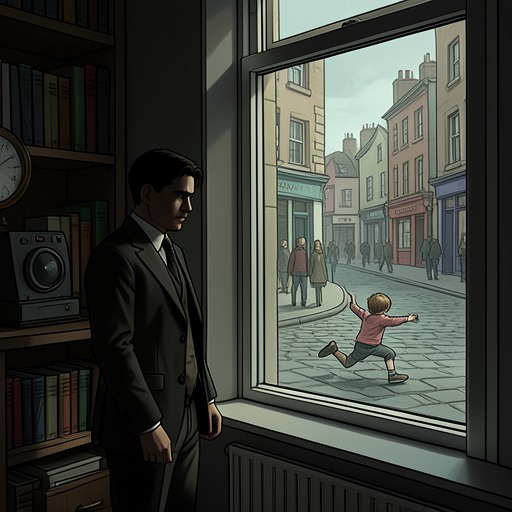
When Bailey finds an old photograph of Owen, she recognizes him despite his changed appearance. She is about to call Hannah when the incoming Signal call arrives. Owen does not say where he is calling from or ask whether she is all right. He tells her he has twenty-two seconds. He apologizes, saying he is sorrier than he can explain and that he had arranged his life so he would never have to make this call. The brief limit gives the exchange a stark shape: he has found a way to reach his daughter, but not a way to resume ordinary contact.
Owen tells Bailey that it will be a long time before he can call again and that he cannot really come home. The message confirms what Hannah has feared and what Bailey struggles to accept. It also distinguishes separation from indifference. Owen has not returned, but the call and apology show that his departure remains a source of pain for him, too. The protective system he built can preserve a channel between them, yet it cannot make that channel equivalent to having her father beside her.
Bailey presses Grady with the question that the call leaves behind: if Owen believes Grady is the best option, why is he still running instead of being with them? Hannah does not offer Bailey false reassurance. When Bailey asks whether her father is coming back, Hannah says she does not think he can. Bailey’s sadness turns toward anger and grief, but when Grady speaks as though he knows Owen, Bailey answers, “No. I know my father.” The statement is not a denial of the danger or the separation; it is an assertion that Owen remains someone she knows through their own bond, not merely through Grady’s account of him.
Separation Without the Erasure of Trust
Hannah’s decision-making gives the father-daughter relationship a further consequence. She considers accepting an Owen-less future if that is what allows Bailey to remain Bailey: to keep her identity, continue growing up, and choose her own life. She tells Grady that Bailey is what she is thinking about, and asks what Owen would have wanted her to do after he disappeared. Her answer to the crisis is shaped by her understanding of Owen’s care, but it does not simply reproduce his choices. It centers Bailey’s safety and personhood, even when those priorities make reunion impossible for now.
The final emphasis falls on Bailey’s knowledge of her father, not on a resolution that restores their household. Owen’s safeguards have protected a possibility of contact, and Bailey’s remembered instructions allow her to recognize the call; neither can promise when he will call again or whether he can return. Their relationship thus persists across enforced distance as a combination of memory, trust, preparation, and grief. Owen’s love is legible in what he arranged for Bailey, while Bailey’s own words make clear that absence has not replaced him in her understanding of who her father is.